Advice for 2026 Erb Fellows Undergrads
Category:
Erb Fellows
News
Author:
Zachary Marmet
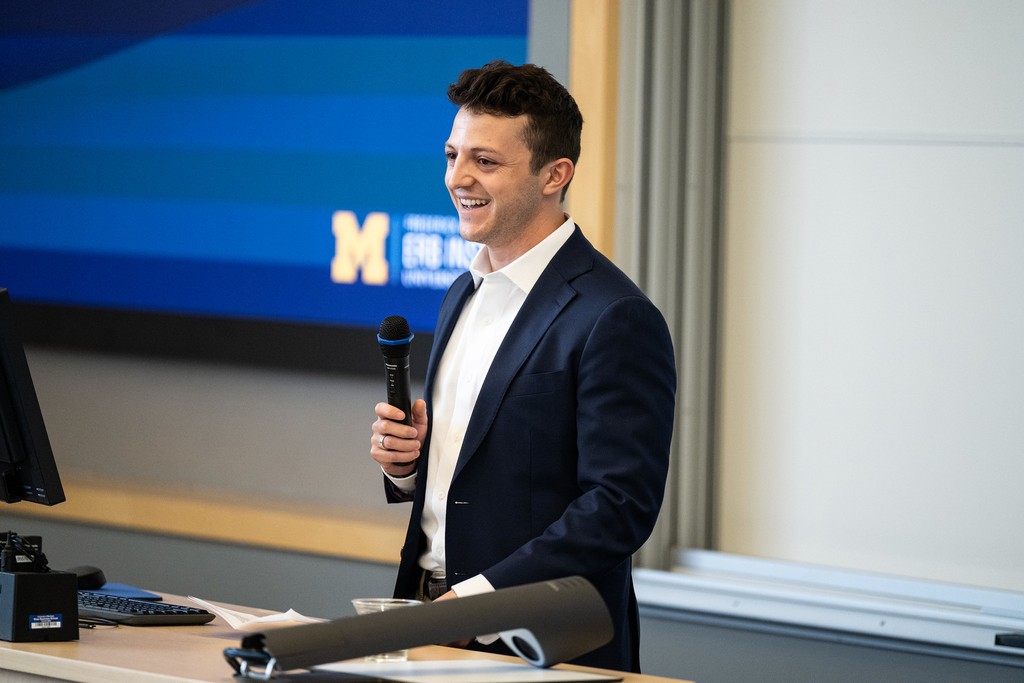
Zachary Marmet graduated from University of Michigan in 2023 as an Erb Undergraduate Fellow. We invited him back this year to speak at the Fellows commencement ceremony. He shared what he's learned since graduation and how the Erb community has supported him as he launched his career. Below are his remarks, edited slightly.
Class of 2026, you have accomplished all sorts of wonderful things in your two years at Erb. You’ve learned from expert professors and been inspired by co-curricular speakers. You’ve taken initiative to establish strong ties with Erb’s dual-degree masters’ students. You have strengthened the Fellows community with your involvement, and had fun touring the Big House and picnicking in the Law Quad along the way.
It’s important that the Class of 2026 is a group who excels, who builds community and solves problems…because, frankly, the world needs a lot more of these sorts of people right now. The problems in the world you’re entering are hugely complex and overwhelming. As Erbers, you’re all acutely aware of the climate crisis and immense environmental degradation that is a by-product of all of our ways of life. But in May 2026, there are greater dynamics also in play (I’ll try not to make this too depressing):
First, the current US administration is doing its very best to politicize climate as a “woke” issue, gutting entire agencies like the EPA and Forest Service, dismantling key climate regulations, and clawing back the funding needed to produce new renewable energy.
Meanwhile, in our globalized world, cooperation is instrumental to solving climate issues. I remember learning via the Shell 2050 climate scenarios in Professor Lyon’s class that one of the biggest threats to climate progress is global competition, as it risks shared innovation and pushes resources towards conflict rather than progress. As the U.S. gets involved in wars spanning Eastern Europe and the Middle East, and longstanding alliances for defense and trade become increasingly strained, we are seeing the impacts of a non-cooperative scenario in real time.
And amidst all of this, the most pressing topic for many of us is even more existential—the rapid growth of AI and its increasing dominance over the economy has us not only asking, “How will we generate all of this power?” but also, “How will I find a stable job?”
All of us feel these threats, even as we live safely in the U.S., are lucky enough to graduate from the University of Michigan, and have bright futures ahead. But what do these existential issues mean for human wellbeing in the world? For future generations? How do we live our lives, and use our careers, to create the future we all deserve?
The first step is to see these challenges not just as our generation’s burdens, but as our opportunities to have a lifelong career of impact. And I’m not just here to be a “climate doomer”—because the opportunities are legit.
As the present government tries its best to make sustainability taboo, we’re seeing companies adjust “sustainability” titled departments into embedded roles in product design, operations, supply chain, and procurement, where these individuals will likely be better positioned to advocate for real decarbonization anyway. As prices rise from tariffs and war-torn supply chains, we’re seeing a newfound push to innovate for circular supply chains and material reuse, to keep critical resources available. And as AI consumes ever-more energy, we’re seeing more private funding going into the renewable energy and grid modernization space than perhaps ever before.
In just a few years in consulting, I’ve seen the way companies talk about sustainability shift from “what should our strategy be” to “how can we make progress toward our goals”—a question that is a lot less performative and a lot more challenging. What these trends remind me is that the core values this community believes in, of sustainability and resilience, of using our resources with care and efficiency, are simply rational.
The landscape may change, the opportunities may change, the buzzwords may change—but the values are not going anywhere. If anything, they are more relevant than ever. As Erb graduates, you are not only bright, but also driven. You’re not just passionate out of self-interest, but you have a genuine care for others and for the world around you. Your values make you unique, and well-equipped to take advantage of the opportunities ahead.
And as you set off on this journey, you are far from alone. As Fellows alumni, you and I are incredibly lucky to be part of a fantastic community: five years of undergraduate alumni and 30 years of dual-degree master’s alumni. This is a community of people who, like you, are talented and purpose-driven. A community who are all trying to strike the difficult balance of an enjoyable, stable, and impactful career. Most importantly for you, this community legitimately wants to help you succeed, and to dress you up in as much Erb swag as possible along the way. I’ll share a few brief examples of how staying close to Erb post-grad dramatically impacted my own career:
Shortly after graduating, Accenture called me out of the blue to let me know my job offer was pushed back eight months, from that summer all the way to April of the next year. Not knowing what to do, I reached out to the Erb network for advice, starting with Melissa Vernon, an alumni who had recently spoken at a co-curricular event. Melissa didn’t just give me advice; she told me that her company, Climate Impact Partners, was coincidentally looking to bring in temporary support for someone on maternity leave… about nine months. A few interviews later, I had found the perfect interim role.
Later, some months into my time at Accenture, I was feeling a bit stuck, having spent my time on projects that felt random and without direction. I decided last-second to attend Erb Returns, the bi-annual reunion in Ann Arbor, and it was an absolute game-changer for my career and mentality. I was inspired by the alumni who shared stories of enacting change over 10, 20 year careers, and simultaneously relieved to find that even the most experienced shared the same struggles and uncertainties of where to take their career next. I applied advice from that particular weekend to intentionally network into Accenture’s sustainability practice, where I have since spent most of my time.
Now as my company unfortunately shifts its priorities away from sustainability, I’ll be turning back to Erb and attending Erb Returns this coming fall. I hope to see you there!
The amount of inspiration to draw from this community is truly incredible, and it’s really limited only by your choice to show up and be involved.
Even with all the support from Erb, it’s not always easy to pursue a career in sustainability. Now, I don’t have decades of experience to draw on, but I can speak to pursuing this field in your 20s, while simultaneously soul-searching and trying to carve out your life path. Some parting words of advice:
We’ve all dealt with imposter syndrome, but it hits especially hard in your early career. The first time you’re asked to share an opinion or present your work, it’s easy to think: “Why should they trust me? What do I know?” And we are all navigating our early careers with a lot of uncertainty about what comes next. I was recently listening to a podcast that drew an interesting connection between imposter syndrome and mentorship. In referencing a study conducted on student tutors, the takeaway was that helping someone else learn often builds innate confidence and trust in your own abilities. As alumni, you will have many opportunities to give advice and support to younger undergrads. I strongly encourage you to do so—not only because it’s generous to pay it forward, but because this mentorship can also help you grow, formulate your own opinions, and build your confidence.
One of my favorite lectures from Professor Hoffman’s class covered the effectiveness of GDP as an economic success indicator. I realize that talking about GDP wasn’t on your bingo card today, but bear with me. He explained that GDP as a representation of prosperity is often a fallacy, and we discussed a few alternative methods to measure success—my personal favorite being Bhutan’s “Gross National Happiness,” which weights 33 indicators including health, family and community, governance, use of time, and environmental conservation. Now the U.S. isn’t going to scrap GDP anytime soon, but as individuals, we can choose to measure our success in more than just a dollar salary, or if we’ve solved the climate crisis yet. When entering the working world, you’re not going to feel powerful. The first years of work usually don’t consist of changing the world—they consist of little wins building on each other, and slowly gaining experience and confidence. While coming to terms with this, I encourage you to measure your success holistically—your relationships, the place you live, your health, your creative hobbies, your intellectual stimulation, the number of times you laugh in a week. Define your Gross Personal Happiness and you will be successful.
My last piece of advice is based on a simple quote from a close friend of mine: "You create your own luck.” Now, you did just get ridiculously lucky, as students here during a football AND basketball national championship. I graduated before either of those and I'm still not over it. But the rest of your luck? You'll have to make it yourself. Successful people often give a lot of credit to luck—they were in the right place at the right time, they met the right person—you know how these stories go. There’s definitely some truth to this, and some humility as well. But what isn’t said is how that person got to the lucky point—by showing up, by being consistent, by engaging with energy, by putting themself in new situations. I believe that particularly at this stage of your life, you have the power to create your own luck.
Class of 2026, you deserve all the celebration this weekend. I hope you take pride in all that you accomplished at Michigan, and wish you well on this new and exciting journey to chase the generational opportunities ahead. The world is a better place with you in it. This Erb community will always have your back. GO BLUE!