A Creative Financial Tool to Boost Regenerative Farming
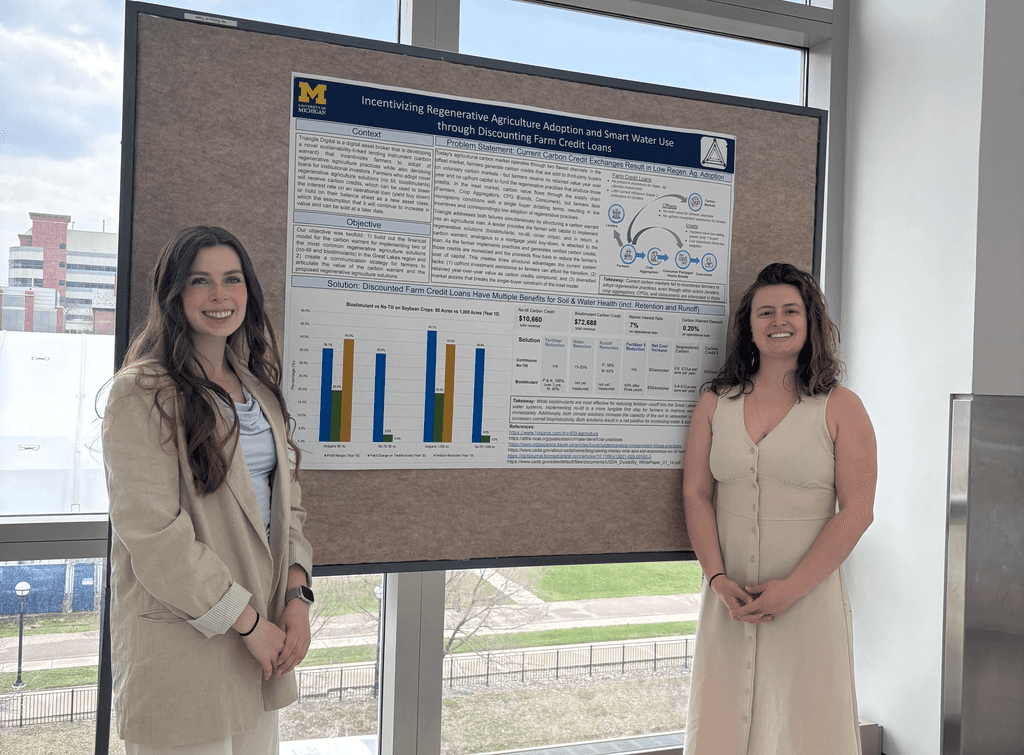
What if we told you that there was a tool, deployable today, which improves soil health, reduces nutrient and water runoff, sequesters carbon, and helps farmers with their squeezed financial margins? Even better, what if it was something farmers, lenders, policymakers, and environmentalists had wanted all along, but had not yet successfully implemented?
This tool isn’t a seed, a tractor, or new irrigation—it’s a creative financial instrument to fund regenerative agricultural solutions, and it can be deployed through existing channels between farmers and their credit unions.
This semester, we conducted an Erb Impact Project with Triangle Digital, a carbon credit company working to support regenerative agriculture. Triangle aims to solve multiple problems in the farming and farm credit space. These include financial challenges like increasing input costs, compressed margin, and ballooning interest rates (hiked 3-4% from 2022–2023); as well as environmental challenges like water scarcity, water quality, and soil health degradation. Consequently, the number of farm bankruptcies increased by 46% from 2024 to 2025, as reported by the American Farm Bureau Federation. At the same time, increasing climate events (i.e., floods, droughts, storms) further complicate farmers’ solvency with financial and environmental risks.
Our project examined Triangle Digital’s potential impact on regenerative agriculture from an environmental and financial perspective. Environmentally, regenerative agriculture promotes healthier plants with deeper root systems that hold onto more rainfall, improving water retention and reducing nutrient runoff. The land also becomes more productive with lower ongoing input costs such as fertilizer and water. When farmers adopt these practices, it benefits their lenders by enabling less risky, higher value assets and lowering these lenders’ Scope 3 emissions.
Triangle’s product, called a carbon warrant, provides the financial structure (built into the typical loan reassessment process) for farmers and lenders. Market signals indicate lenders will be willing to offer up to a 0.44% discount to incentivize these practices, a meaningful difference for farmers seeking upfront investment for regenerative agriculture.
Beyond this short-term financial boost, Triangle’s carbon warrant leads to long-term benefits. Farmers who implement regenerative agriculture solutions realize a multitude of benefits, including up to a 20 bushel per acre increase in crop yield, healthier soil, lower year-to-year fertilizer costs, and more stable year-to-year revenue. Lenders benefit from a 50/50 split of the associated carbon credits from the carbon sequestration.
Currently, each party can sell these credits annually via the offset or inset market, and in the future state (once carbon is regulated as a digital asset), farmers and lenders can hold the credits on their balance sheet and bet on their appreciation with time. This revenue stream, shared between farmers and lenders, can encourage adoption.
We saw first-hand how with the right financial instrument, conservation outcomes and economic returns can be structurally aligned. This same model could be extended to other areas of conservation finance—wetland preservation, sustainable forestry, or coastal resilience—wherever ecosystem services can be quantified and monetized. If Triangle's model proves out in farm credit markets, it offers a replicable blueprint for mobilizing private capital toward the full breadth of conservation challenges that public funding alone cannot meet.