Is Carbon Reporting Really Dead? We Spent Our Summer Interning at a Sustainability Consultancy and the Answer Is No
Category:
Student Voices
Student Internships
News
Author:

It may feel like the sustainability movement has lost some of its momentum in recent years. In the U.S., federal funding for decarbonization projects has been clawed back and certain renewable energy investment tax credits (ITCs) ended this past July. Companies are increasingly reassessing how climate initiatives fit into their long-term strategies. Some companies revised their overly ambitious targets, failed to meet them, or completely abandoned them. Walmart acknowledged in their 2024 annual report that they would fail to meet their 2025 emissions target (slashing 60% of emissions by 2025) and recycling goals. In 2025, BP announced a “strategic reset”: scrapping their aggressive goal of reducing fossil output by 40% and focusing instead on “reallocating capital to highest returning businesses,” which means predominantly oil and gas.
Our summer internship at Positive Scenarios Consulting—a boutique sustainability consultancy specializing in impact accounting, climate strategy, and reporting—revealed a more nuanced reality. Sustainability is evolving from ambitious public commitments towards pragmatic investments in data, risk management and compliance. Annual reporting through CDP or EcoVadis moves even small companies towards improved supply chain data management, increased knowledge of environmental impacts, and stakeholder transparency. Companies far along the maturity curve are working ahead of legislation to utilize their emissions and climate risk data to make key business decisions.
We began our internship as many companies begin their environmental sustainability journey: with a greenhouse gas inventory. Emissions are embedded throughout an organization’s supplier networks, transportation systems, and product use and end-of-life processes. Building a GHG inventory requires companies to develop stronger data-management capabilities across their value chains. Due to the time and resources required to invest in such systems, companies often exclude Scope 3 emissions in their initial inventories. However, Scope 3 can drive up to 90% of a company’s carbon footprint, so mapping this scope is important to gain a more accurate and transparent understanding of a company’s emissions profile.
Large companies, including our client this summer, may manage their direct emissions (Scope 1) and indirect emissions from the purchase of electricity (Scope 2) in-house, but seek outside support for Scope 3. Our work involved helping to map the client’s Scope 3 emissions across multiple operating companies and complex global supply chains. See Figure 1 below for a representation of Scopes 1, 2, and 3 GHG Accounting.
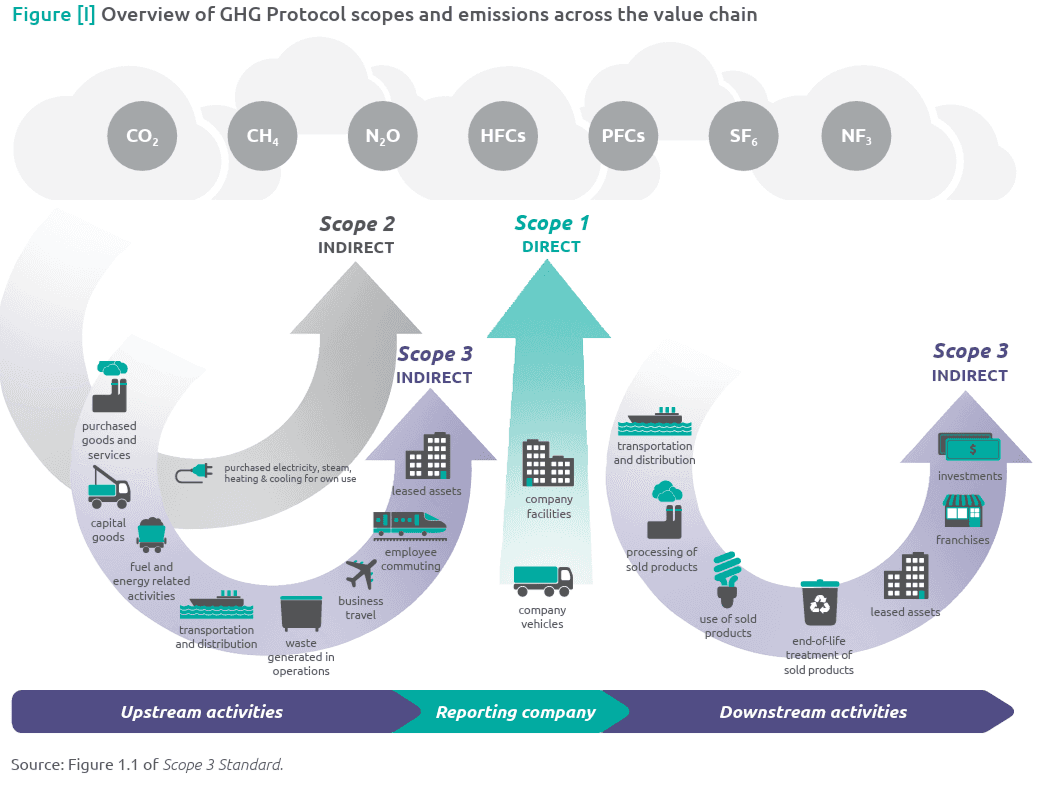
After a company has created a GHG inventory, it can disclose its emissions in a public report or submit the data to reporting agencies like CDP (formerly Carbon Disclosure Project) or EcoVadis. Through our work this summer, including small/medium enterprises, we saw how this GHG dataset can drive greater climate commitments.
As a result of PSC’s consistent support over the past three years, a branded merchandise and apparel client with roughly 100 employees decided to publish their ESG Fact Sheet on their website – a strong signal to customers, investors, and employees that they are backing their sustainability promises with concerted action.
Multiple PSC clients have also moved beyond data collection and disclosure into operationalizing sustainability within their business and seeing its value daily in decision-making.
Through conversations with PSC coworkers, we learned about additional climate strategy projects that moved the needle including food and beverage giants who can’t afford to ignore their climate risks and opportunities. For a major dairy client, robust scenario analysis from PSC determined that over 90% of their ingredient supply chain is under medium- to very high-risk likelihood from thermal stress and temperature change. Further, PSC modeled what effect emissions reductions initiatives could help them achieve their GHG reduction targets of 20% by 2035—even as the business grows rapidly. These insights helped the client accomplish their GHG reduction targets and preemptively prepared them for mandatory climate reporting, such as in the state of California.
These conversations were especially enlightening given how the reporting landscape is in flux. Revisions to key standards including the Corporate Standard, Scope 2 Guidance, and new Actions and Market Instruments guidance, are expected to reshape how companies account for emissions reductions, energy procurement, and the use of environmental attribute certificates. Simultaneously, the development of new Land Sector and Removals Guidance aims to bring greater consistency and credibility to accounting for carbon removals and land-based emissions. Adding to this evolution, closer alignment between the GHGP and ISO greenhouse gas standards is intended to improve interoperability and reduce inconsistencies across reporting frameworks. Together, these developments enable a more rigorous, harmonized, and decision-useful approach to corporate climate reporting, which can itself drive greater market adoption. So, no, carbon reporting isn’t really dead – in fact, it’s just waking up.