Meet Melissa Zaksek, Erb’s Managing Director
Category:
30th Anniversary
News
Author:
Bryce Huffman
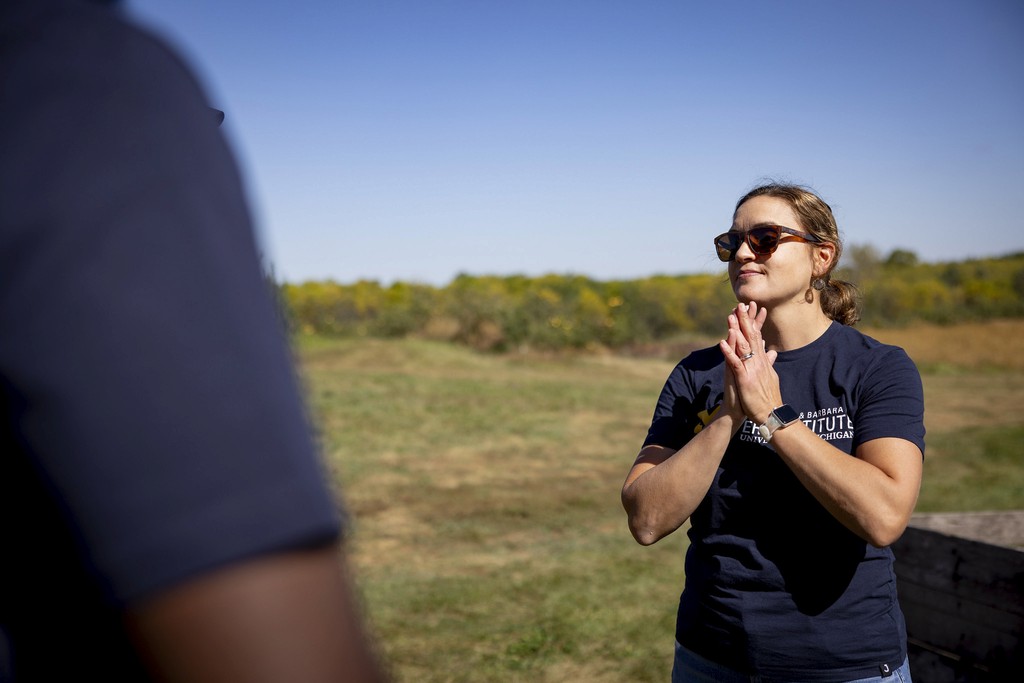
Long before becoming the Managing Director of the Erb Institute at the University of Michigan, Melissa Zaksek knew that her joy of the outdoors would be a North Star for her career.
“My dad gave me such a great opportunity to really get to see the state,” Zaksek said. “We camped a lot, we would hike and spend a lot of time on the Lake Michigan beaches growing up, and for me, I just personally get so much from spending time outside exploring our land and our water. My own personal love of the outdoors is what steered me into sustainability in the first place.”
Understanding that these lakes, rivers, and forests in the Great Lakes state need people working constantly to protect them, fueled Zaksek to study forestry at Michigan State University and natural resources at the Ohio State University. It’s this stewardship mindset that led to her early-career work with the US Forest Service, where she worked on forest fire policy and landscape scale ecological restoration initiatives.
From passion to profession
This passion is palpable when Zaksek discusses the importance of sustainability and the work students and faculty are doing at the Erb Institute, now in its 30th year of operation.
The Institute, which is a partnership between the Ross School of Business and the School for Environment and Sustainability, works to bridge the gap between corporate interests and environmental conservation. When she came to the Institute in 2017, she had a strong background in sustainability but little experience in the corporate world.
“Even though I came into the Erb Institute knowing little to nothing about the industry, what I did know was that business has such a tremendous role and potential negative or positive influence on social, environmental, and economic sustainability,” Zaksek said.
That first year, Zaksek says, gave her a look at how business leaders make decisions about sustainability. Understanding the decision-making process from industry leaders, she says, helped her guide the programming offered to students.
“I became very involved with the business engagement platform of the Institute, partnering with our corporate allies and our alumni, and helped to launch our Michigan Business Sustainability Roundtable, which has just been such a tremendous resource for the Institute,” she said.
A systems level view of sustainability
A throughline of Zaksek's work at the Institute is fostering and deepening a systems-level approach to sustainability — one that brings people together in a shared effort to examine the bigger picture and surface the deeper, often invisible systems at play. That starts, she says, with building the habit of asking better questions.
"It's not just 'how much emissions is a factory putting out into the air,' or 'is it better to drive an EV or an internal combustion car?' It's much, much more complex than that," she said. "It's 'who produced that car?' And 'is there child labor in the supply chain? How are communities impacted by the production of the products that you're producing or consuming?'"
"I think it's just continually thinking about and asking, 'who are we not thinking about? What are the complexities that need to be taken into account?'" she added.
It's the kind of thinking that Zaksek sees as an ongoing, collective practice — one she embraces as a challenge worth showing up for every day, alongside the students, faculty, and partners she works with.
Tension between business, the community, and the environment
Corporate partners, regulators, environmental activists, and community members don’t always understand or share each other’s values or needs, which is why Zaksek pushes for everyone to have a seat at the decision making table. She believes that real progress can only be made by getting everyone, whether they are coming from a corporate or environmental conservation or other perspective, to develop climate or sustainability solutions together.
“I've just seen so much success come out of projects, programs, policies, when they are co-created by all of the stakeholders,” she said. “And that can feel slower at first, but that investment up front has a much longer return and is more likely to be successful.”
This collaborative spirit is one that Zaksek says involves removing ego from the equation.
“It’s easy to work together when we take our own egos or our own wants out of the equation for just a second,” she said. “Then we can all say ‘what’s in everybody’s best interest? How about we do that?’”
The future of Erb and its students
While the Institute is celebrating its 30th year, Zaksek says the challenges facing the sustainability efforts can sometimes feel insurmountable. Until she talks to her students.
“I'm continually impressed with our undergraduate and graduate students. I think they're just, they're really impressive students, and they give me a lot of hope,” she said.
There are other times when it’s the students who need that encouragement from Zaksek or others at the Institute. In those times, she knows can rely on the program's alumni and its founders.
“While it can be discouraging to see how much work still lies ahead, it's also really inspiring knowing that, because we have such a solid foundation, because of the foresight of our donors, of Fred and Barbara and others, that we can keep doing this,” Zaksek said. “We're here for the long haul, and that's really encouraging for us to know that we're not going anywhere, and we're going to just continue to try to deliver on our mission.”