From First-Gen Student to Sustainability Leader: How the Erb Fellows Program Changed My Path
Category:
Erb Fellows
News
This article is adapted from remarks delivered by Kaylynn Budreau, an Erb Undergraduate Fellow, during the Erb Institute’s Strategic Advisory Committee lunch.
Throughout my time at Michigan, I’ve been fortunate to be part of many incredible communities — clubs like the Environmental Consulting Organization at Michigan, the Michigan Ski and Snowboard Club, the Dean of Students Advisory Board, and many more. But none of these experiences have shaped me as profoundly as the Erb Undergraduate Fellows Program.
When I first arrived on campus, I often heard the phrase, “It’s not what you know, it’s who you know.” For a first-generation student like me, that was extremely intimidating. I didn’t have a network of professionals to reach out to in sustainability, business, or leadership. I didn’t have family connections to call for advice about navigating college or planning for life after graduation. In fact, I had never even stepped foot on a college campus before submitting my commitment deposit to Michigan.
And while I was $350 down and anxious, I was also curious, determined, and deeply concerned about our shared future — for our planet, our communities, and the systems that connect them.
The Erb Fellows Program changed everything for me. It taught me that sustainability is a way of seeing and understanding the world — that it is about recognizing how our economic, social, and environmental systems are interconnected, and how every decision we make has a ripple effect.
Through the program, I’ve built connections with students from Ross, PitE, and the Erb Master’s program, all bringing diverse perspectives, experiences, and goals together. I’ve also had the opportunity to connect with professionals who’ve shown me what a career in sustainable business can look like — people who’ve provided the mentorship and guidance I once didn’t know how to find.
Through the Erb Fellows Program, I’ve been able to take several Ross business classes and sustainability-focused courses that have pushed my thinking and helped me understand, holistically, the influence companies have on shaping our future. Business has the reach, creativity, and responsibility to lead this transformation — but it requires a shift in mindset. It requires redefining what success looks like.
I see sustainability as both a mindset and a lens — a way of thinking that shapes how we approach every challenge and opportunity. I believe that it is only through this lens that long-term success can truly ever be achieved.
I’ve been fortunate to apply this way of thinking through hands-on experiences and opportunities that I largely credit the Erb Fellows Program for preparing me to pursue. Without the skills, confidence, and community I gained through Erb, I wouldn’t have been able to earn or excel in these roles.
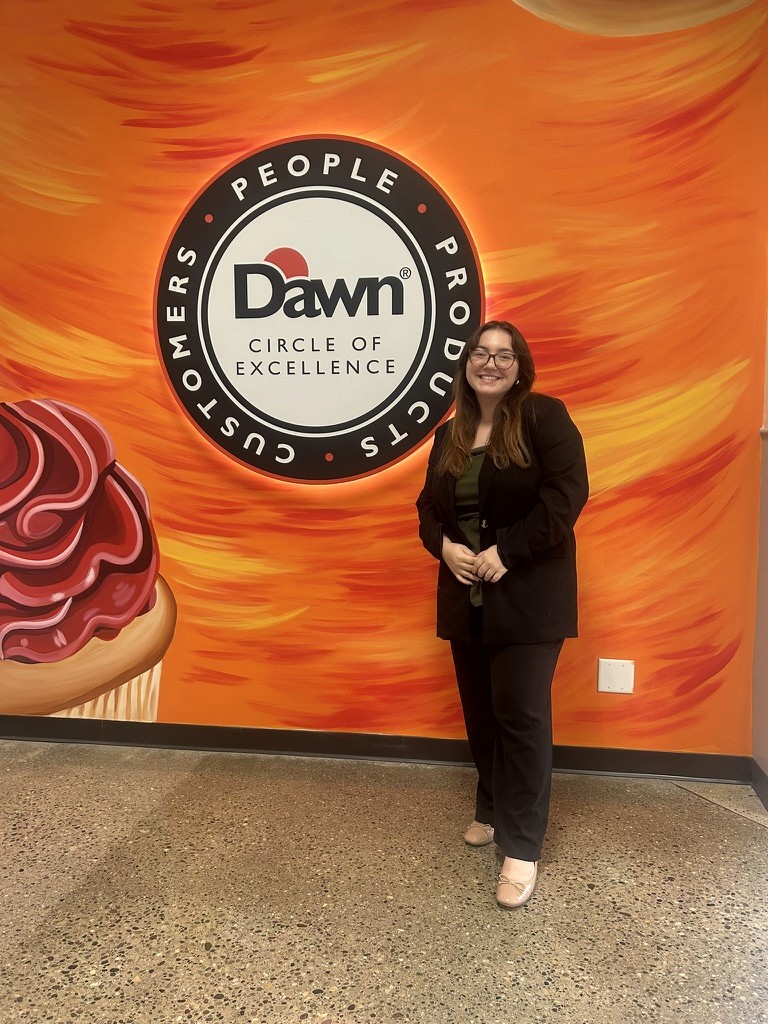
This past summer, I interned with Dawn Foods Global on their Corporate Environmental Health and Safety team, where I worked to embed sustainability into the operations of a global food manufacturing company and baking industry leader. I developed an environmental compliance calendar and management system that was implemented across all of their North American facilities — both distribution centers and manufacturing plants — and trained staff on how to maintain it. I also had the opportunity to collaborate with international teams, learning about global sustainability policy and working to standardize and translate over 200 EHS safety trainings into multiple languages, making the company’s environmental and safety programs more inclusive and accessible.Before that, I interned twice in various roles with the City of Battle Creek’s Environmental Department, where I had the opportunity to work in every department in the city, conduct fieldwork, analyze sustainability data, and strengthen community engagement through the City’s Environmental Outreach Program. That experience showed me how local governments navigate real-world environmental challenges, balancing compliance, education, and public trust.
Back on campus, I’ve carried those lessons forward through my work with the Planet Blue Ambassadors Program at the Graham Sustainability Institute and as a Peer Advisor for the Program in the Environment. With Planet Blue, I’ve helped lead sustainability education for over 9,500 incoming students, planning and facilitating orientation events that inspire students to integrate sustainability into their daily lives.
As a Peer Advisor, I support students as they plan their courses, explore new opportunities, and navigate those same early questions I once had: Where do I fit? How do I begin?
When I sit down with students who are uncertain about their path, I see a reflection of who I was when I first joined the Erb Fellows Program — someone curious, determined, and eager to make a difference, but unsure of how. Erb gave me a community that opened doors, connected me with professionals, and helped me envision what’s possible.
Those mentors and experiences have shaped who I am today, and I hope that as I grow in my career, I too can one day become a leader in this field like so many of the people who have inspired me along the way.
One takeaway that has stayed with me from an Erb curriculum course comes from a book called What If We Get It Right? by Ayana Elizabeth Johnson. She writes about how the difference between an ice age and the world we live in now is only about four degrees Celsius — and the impacts of our choices today, especially our business decisions, will unfold not in some distant future, but within our own lifetimes.
Many of you may have heard about the recent climate news: scientists have shared that we have officially reached one of the many tipping points in the advancement of global climate change, and unfortunately, we have officially lost coral reefs — in the sense that nothing we can do can save them from extinction.
For so long, sustainability has been framed as something for future generations to worry about. But it’s not. We’re living through the consequences now, which are the direct results of choices made in our boardrooms, our factories, and our governments.
And that means the choices we make today — in our classrooms, our internships, and our careers — will shape not just the world we leave behind, but the one we live in right now.