Erb’s First Graduate Looks Back
Category:
30th Anniversary
Alumni
News
Featured
This story is part of Erb’s 30th Anniversary series, celebrating three decades of impact at the intersection of business and sustainability.
Laura Rubin (MBA/MS ’95) knew early on that business and the environment were intertwined. She came to the University of Michigan to pursue her graduate degree at the School of Natural Resources (now the School for Environment and Sustainability, a.k.a. SEAS), but she had studied business economics in college and saw the value.
For so long, the philosophy had been that “business and the environment really didn’t mix,” said Rubin. If you wanted to make a profit, you couldn’t care about the environment and vice versa. But this was the 1990s and the concept of corporate sustainability was on the horizon.
Rubin could sense that things were starting to change, and when she approached Joe White, the dean of the business school, to let him know she was interested in taking classes, he told her they were actually thinking about how to create a dual program. “And I said, I might be really interested in a joint-degree program.”
White and SNRE Dean Garry Brewer saw her potential and invited her to accompany them to Chicago for a fundraising dinner, where she talked about her passions and interests. “I was sort of the guinea pig there,” she said. The dinner went well, the degree was set into motion, and Rubin would go on to become the Erb Institute’s first graduate (and, according to some, an Erb icon).
Changing and Challenging the Conversation
It wasn’t always easy. The B-school (it hadn’t yet been named the Ross School of Business) kids had been following a rigorous program for a few years, and Rubin was a bit of an outsider when she finally enrolled as a dual-degree student. She said she was “seen more as a hippie.” Meanwhile, the environmental school students thought she was a sellout. “I definitely felt like the oddball in both schools,” said Rubin. “It was challenging.”
However, she made friends and found her peers (particularly among international students who came from places where sustainability was more integrated into their ethos), and she saw that she was bringing a valuable new perspective into the classroom. “Early in my classes, I used case studies where I could weave these two sectors together and these interests together.” For example, during discussions of free trade and the North American Free Trade Agreement (NAFTA), she would raise environmental issues. “I would bring in externalities that I think many of the other students hadn’t thought of,” she explained.
The work paid off. Upon graduation, she had completed coursework in hard sciences, social sciences, policy behavior, environmental justice, conservation biology, and river ecology. The business school gave her foundations of accounting, strategic planning, and marketing. She also cited a pivotal class on leadership with Robert Quinn, and one on creativity and business with Jeff DeGraff, as being particularly helpful. “One of the greatest values I think that I got out of my master’s degrees was that broad interdisciplinary learning.”
As she pursued a career in the nonprofit sector, she drew on this multidisciplinary background. “It was a very unusual dual degree,” she said. “And it gave me the skills to succeed. In addition to the science and technical skills, I drew on strategy, marketing, finance, and leadership skills.” She added, “You still need to bring in a profit. You still need to have more revenue coming in than expenses going out.”
Impact in Practice
Today, Rubin leads the Healing Our Waters-Great Lakes Coalition, which represents over 200 groups working to restore and protect the Great Lakes. Their work touches almost every aspect of the watershed as they advocate for federal investment in environmental restoration, pollution cleanup, repairs to ailing drinking-water infrastructure that serves over 30 million people, and more. She said that while it’s tricky to align such diverse communities and organizations with unique needs, “the value of unifying people around a consistent message and a consistent voice is very effective at bringing about change.” Plus, she’s never been afraid of a challenge.
Room for Optimism
A lot has changed since Rubin graduated in 1995. The Great Lakes are getting warmer, non-native species continue to pose new threats, microplastics and PFAS are everywhere, and we’re seeing the active dismantling of federal environmental protections (all of these are topics that Rubin actively works on). “Under this current administration, there are a lot more challenges,” she said, noting that the government sector has been cut along with research funding, which limits opportunities for graduates to go into policy or become civil servants.
Nonetheless, Erb will soon be able to say it’s launched 1,000 graduates into the world, and there’s reason to be optimistic as sustainability work has come a long way since the 1990s. Rubin encouraged new grads to think creatively about how they can integrate sustainability across all sectors, from senior care to the music industry to health services. “When I was graduating, those options weren’t available,” she said. “But people see those connections now.”
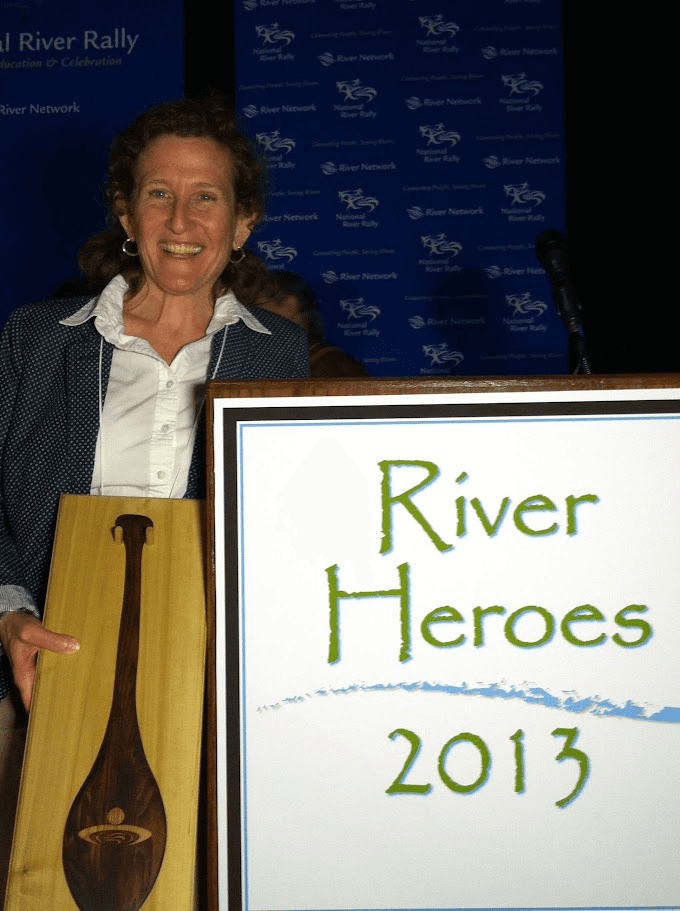
In 2013, Laura Rubin was recognized as a River Network River Hero