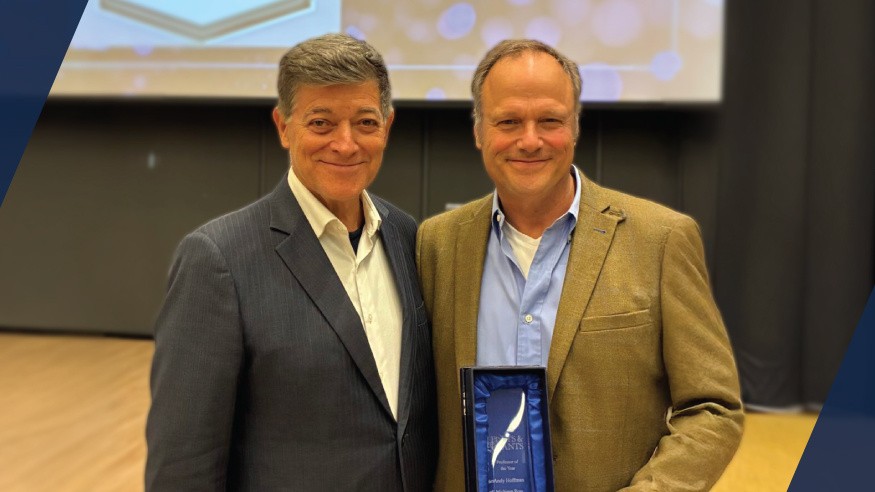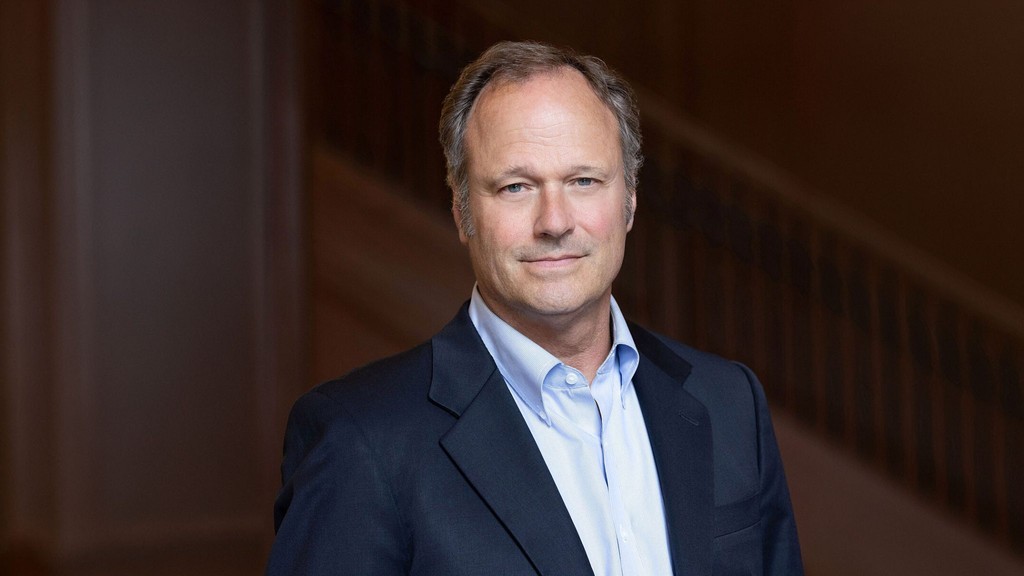
Andy Hoffman named Poets&Quants’ 2025 MBA Professor Of The YearThis month at a ceremony in Toronto, Poets&Quants named Erb Institute faculty member Andy Hoffman its 2025 MBA Professor of the Year. Hoffman is the Holcim (US) Professor of Sustainable Enterprise, and he recently published the book Business School and the Noble Purpose of the Market: Correcting the Systemic Failures of Shareholder Capitalism. At the Erb Institute, we are extremely proud of Andy and this well-deserved recognition for his years of service, contributions, and thoughtfulness to our shared community across the Ross School of Business and School of the Environment and Sustainability.
In an interview with the institute, Andy reflects on this award, how his approach to teaching has shifted, and where he sees business education going.
Erb Institute: How has your approach to business education changed over the years?
Professor Hoffman: For the last five years, I've been focusing on the need to reform and rejuvenate business education. Prior to that, I was trying to fit the issues that matter in the world into business and business education as it exists. I was taking issues like climate change and income inequality and trying to fit them into a curriculum that has remained unchanged and still says: The purpose of the firm is to make money for the shareholder, government has a limited role in the market, efficiency is always good, and people are inherently selfish. That's all embedded within the curriculum, and simply adding an elective on climate change, for example, is just not going to work. We have to change the curriculum to properly deal with these issues. I've sort of inverted my approach from fitting it in to challenging it.
Erb Institute: How has this shift in your approach also changed your teaching philosophy?
Professor Hoffman: I've developed three new courses over the last five years, including: Business in Democracy, a joint course with the School of Public Policy; Reexamining Capitalism, which teaches students about capitalism in its multiple forms, how it emerged, how it's evolved, and where it may need to change; and Management as a Calling, which steps outside the box on how we approach business education. I think students are resonant with the idea of their career as a calling or a vocation in business, to serve society, to make the world a better place through business. I think this kind of an appeal is necessary, because if our primary goal in business school is to create people who simply want to get rich, we're doomed. We really need to bring a different sensibility into business education.
Erb Institute: What does this award from Poets&Quants mean to you at this point in your career?
Professor Hoffman: I feel like this award is validation that I'm going in the right direction and that I'm pushing on the right issues. I'm flattered and I'm honored, but to be fair and honest, I have to look around and recognize that there are other professors developing courses trying to push in the same direction. There are organizations like Responsible Research in Business and Management and the Alliance for Research on Corporate Sustainability that are also working on changing business schools. Notre Dame has a program called Virtues & Vocations, and Rebecca Henderson at the Harvard Business School teaches a course on doing the inner work necessary to understand who you are before you can connect with the social and natural worlds around you.
Erb Institute: In what ways have students surprised or challenged you?
Professor Hoffman: The way that students have embraced Management as a Calling and Reexamining Capitalism has really been inspiring. When I started Management as a Calling, I had an idea and a structure, but I had a team of TAs that were really helpful in forming it. And each year I have new TAs that play a strong role in making the program go. That is so important, because the key is creating an environment where people feel safe, authentic, and willing to open themselves up. And we have to model that, too. We have to create that culture, and the TAs help me do that. It is fun to watch them embrace it and own it and help make it happen. And the students who participate make it happen, too.
I hesitate to call this a course. It's a program, because I am not a teacher in the standard sense, where I stand in front of a U-shaped classroom and I am the center of attention, and I bring this knowledge into the classroom. That's not how this one works. David Brooks says you learn character like you learn a craft. You don't learn it by reading a book or taking a class. You learn it by doing it or putting yourself in an environment where the ideas are infused. And that's my role in running Management as a Calling: I'm almost like a systems architect. I create the environment. I keep it moving, but the real work is the students. And that's the whole thing about a calling: I can't teach you your calling. You have to find it. And if you don't take the challenge seriously, you'll never find it. When I watch the students just embrace this idea and dive right in, I'm so gratified, I'm so pleased, and I'm so humbled, because, quite frankly, they are so far ahead of where I was at their age .
Erb Institute: What do you hope students take away with them after taking your courses?
Professor Hoffman: For Management as a Calling, I hope they come away with a stronger sense of who they are, what motivates them, and the legacy they want to leave. I hope it instills in them a greater resilience — a greater clarity on what they're trying to do in life, so that they won't just settle for a job that may make a lot of money but doesn't really fulfill them in terms of what they think they're here on Earth to do. I think Erb students are already there in many ways.
This may sound funny, but in some ways, I've been moving away from the word “sustainability.” I feel like sustainability is an issue that has been sort of compartmentalized, and the real challenge right now is to create a new ethos within the business school overall. It's not really about bringing sustainability into the curriculum. It's about shifting from a focus on the how of business to bringing serious attention to the why of business. And for each student, that why is different, and if they don't take the time to examine it themselves, they're just going to adopt somebody else's definition. And that won’t lead them towards a career that will make the biggest difference that they're capable of.
In Management as a Calling, I share a quote from Mark Twain: “The two most important days in your life are the day you are born and the day you find out why.” I tell students they had no choice in that first day — their parents made that choice for them — but the second day, they have to find it themselves. For a small number of people, it just comes to them, and they're gifted. But most people have to put a lot of work into it, and it's a lifelong pursuit. I tell the students in the program to expect unfinished work. You will not come out of this and say, “Done.” This is something you will work on for the rest of your lives.
Erb Institute: What advice would you give the next generation of leaders who want to drive change through business?
Professor Hoffman: The advice I put in Business School and the Noble Purpose of the Market is threefold. Recognize that business schools are broken. That's number one. Number two, go anyway. The power you have to make a difference in the world through business is enormous. Number three, take control of your education. Don't be a passive consumer. Don't just say, “What courses should I take in order to get the degree?” and move on. Recognize that you’re dropped into a resource-rich environment and take full advantage of the whole scope of what's before you, whether it's clubs, organizing a conference or a workshop, bringing a speaker to campus, doing an independent study, or going to seminars around campus, in engineering or public policy, or you name it.
Erb Institute: What makes the Erb Institute and its students unique within the broader business education landscape?
Professor Hoffman: When the Erb Institute was formed in the mid-1990s, it was provocative and innovative. Bringing these two schools together was a new idea. Right now, I feel that the challenge that is before Erb is to try and change Ross and almost, in a way, make itself unnecessary by diffusing these ideas of what is so important — around what the market is doing to the natural environment and the social environment — and to make Ross into a model for change to steer the power of business towards addressing these problems. To do what Paul Polman challenges in his book Net Positive, to have companies make money from solving the world's problems, not from creating them.
I think that ethos is in Erb. The Erb Institute created an identity for students, and somewhat of a critical mass of students, so that these ideas can come into the classroom and have to be discussed, and they can't be dismissed easily. But the real challenge before us is changing business education more broadly, not creating a separate pocket where these ideas can exist within business education.
Erb Institute: Do you see business education starting to move in this direction?
Professor Hoffman: I think there's a lot of work to get it steered in that direction. There's a lot of forces for inertia, but I see small pockets of people who want to drive change. I'm hopeful that these isolated pockets of energy will, over time, grow and diffuse and coalesce and form a solid movement for change. Students are a big part of that. I'm seeing the energy that students have here at Ross, I've seen it at Berkeley, I've seen it at Stanford. Students want more.
I hope that people see this award as one more signal that it's time for business schools to change. I think of it like we're at the beginning of the innovation S curve, and there's a critical mass forming. We need that S curve to turn and start to increase steeply. They say change happens slowly, slowly, slowly, and then all of a sudden. I hope that this is a spark, or one of many sparks, that will make that rapid growth happen.